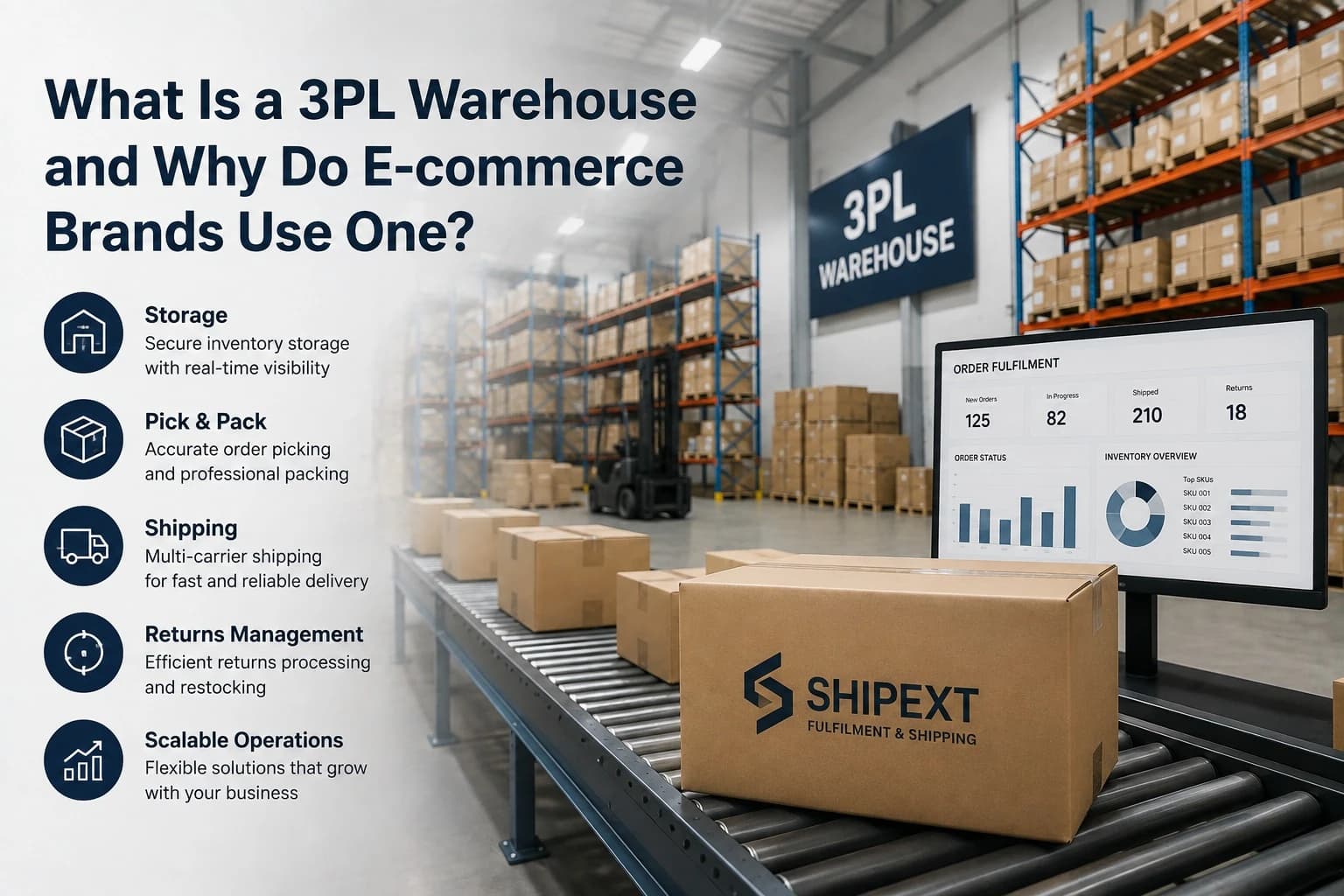
As an e-commerce business grows, logistics can quickly become one of the most time-consuming parts of the operation.
Products need somewhere to be stored. Deliveries need to be received. Orders need to be picked and packed. Parcels need to reach customers, and returns need to come back somewhere.
A third-party logistics provider, commonly known as a 3PL, can manage these processes on behalf of the business.
What Does 3PL Mean?
3PL stands for Third-Party Logistics.
Instead of operating its own warehouse and managing every logistics process internally, an e-commerce company can outsource some or all of these operations to a specialist logistics provider.
A 3PL warehouse can become an extension of the client's business.
The seller manages products, customers, marketing and sales while the 3PL manages the physical movement of inventory.
How the Work Actually Gets Done
The exact services vary between providers, but an e-commerce 3PL can typically support several areas.
1. Receiving Inventory
Products are delivered from your supplier, manufacturer or existing stock location to the fulfilment warehouse.
The warehouse receives the shipment, identifies the products and registers the incoming inventory.
Depending on the service required, this stage may also include product counting, basic condition checks and SKU verification.
2. Storage and Inventory Management
Once received, products are assigned to suitable storage locations.
Depending on the type and quantity of inventory, products may be stored in cartons, bins, shelves or on pallets.
Organised storage makes it easier to locate inventory quickly when customer orders arrive.
3. Pick & Pack
When an order is received, the required product is picked from its warehouse location.
The order is then checked and packed according to the product and shipping requirements.
Some businesses may also require additional services such as custom packaging, inserts, bundling, relabelling or protective packaging.
4. Shipping
Once packed, the parcel is labelled and prepared for dispatch.
The appropriate shipping service can be selected according to factors such as:
- Destination
- Parcel dimensions
- Weight
- Delivery speed
- Carrier availability
- Shipping cost
A fulfilment operation working with multiple carriers can provide greater flexibility when choosing shipping services.
5. Returns Management
Fulfilment does not necessarily end when the parcel reaches the customer.
Customers may return products for many different reasons.
Returned inventory may need to be:
- Received
- Identified
- Inspected
- Photographed
- Repacked
- Restocked
- Forwarded
- Disposed of
Having returns and fulfilment managed from the same warehouse can simplify this process considerably.
6. Amazon FBA Preparation
A 3PL may also prepare inventory before it is forwarded to Amazon fulfilment centres.
This can include FNSKU labelling, packaging, bundling and carton preparation.
Who Can Use a 3PL?
Fulfilment services can support businesses selling through platforms such as:
- Shopify
- Amazon
- eBay
- TikTok Shop
- Etsy
- WooCommerce
- Independent e-commerce websites
The right fulfilment structure depends on the products, sales channels, order volumes and shipping destinations of each business.
3PL vs Running Your Own Warehouse
Operating your own warehouse provides control, but it also introduces additional responsibilities.
A business may need to manage:
- Warehouse rent
- Business rates
- Utilities
- Insurance
- Warehouse staff
- Equipment
- Packaging supplies
- Inventory systems
- Carrier relationships
- Health and safety
- Returns
For some businesses, operating their own warehouse makes sense.
For others, outsourcing to a 3PL allows them to access warehouse infrastructure without building the entire operation themselves.
When Should an E-commerce Business Consider a 3PL?
There is no single order volume at which every business should outsource fulfilment.
However, several signs may indicate that it is worth considering.
You may benefit from a 3PL when:
- Packing orders takes too much of your team's time
- You are running out of storage space
- Your order volumes are becoming difficult to manage
- You want a UK warehouse without operating your own facility
- You need professional returns processing
- You sell through multiple channels
- You need both direct-to-consumer fulfilment and Amazon FBA support
- You want access to multiple shipping options
Can International Sellers Use a UK 3PL?
Yes.
A UK-based logistics partner can be particularly useful for international businesses selling into the UK market.
Inventory can be positioned within the UK and then fulfilled locally rather than sending every individual customer order internationally.
A UK warehouse can also provide a domestic location for customer returns.
The appropriate customs, tax and regulatory requirements still need to be considered separately by the seller.
Why Flexibility Matters
Not every e-commerce company has the same logistics requirements.
One seller may need primarily pallet storage and Amazon FBA preparation.
Another may require daily direct-to-consumer fulfilment.
Another may mainly need a UK returns address and product processing.
A flexible 3PL operation can combine these services according to the client's requirements.
Choosing a UK 3PL Partner
Before choosing a fulfilment provider, consider asking:
- How is inventory received and recorded?
- How is stock stored?
- What are the pick and pack charges?
- Which carriers are available?
- How are returns processed?
- Can the operation support Amazon FBA as well as direct-to-consumer orders?
- How does pricing change as order volume increases?
- What additional handling services are available?
The cheapest headline price is not always the most important factor. Operational flexibility, communication and the ability to support growth can be equally important.
Shipext 3PL Services
Shipext provides UK-based logistics services for e-commerce businesses, including:
- Goods receiving
- Carton and pallet storage
- Pick & pack
- E-commerce fulfilment
- Shipping
- Amazon FBA preparation
- Returns processing
- Product handling
- Pallet operations
If you are looking for a UK 3PL partner, contact Shipext and tell us about your inventory, sales channels and expected order volumes.
Get in Touch