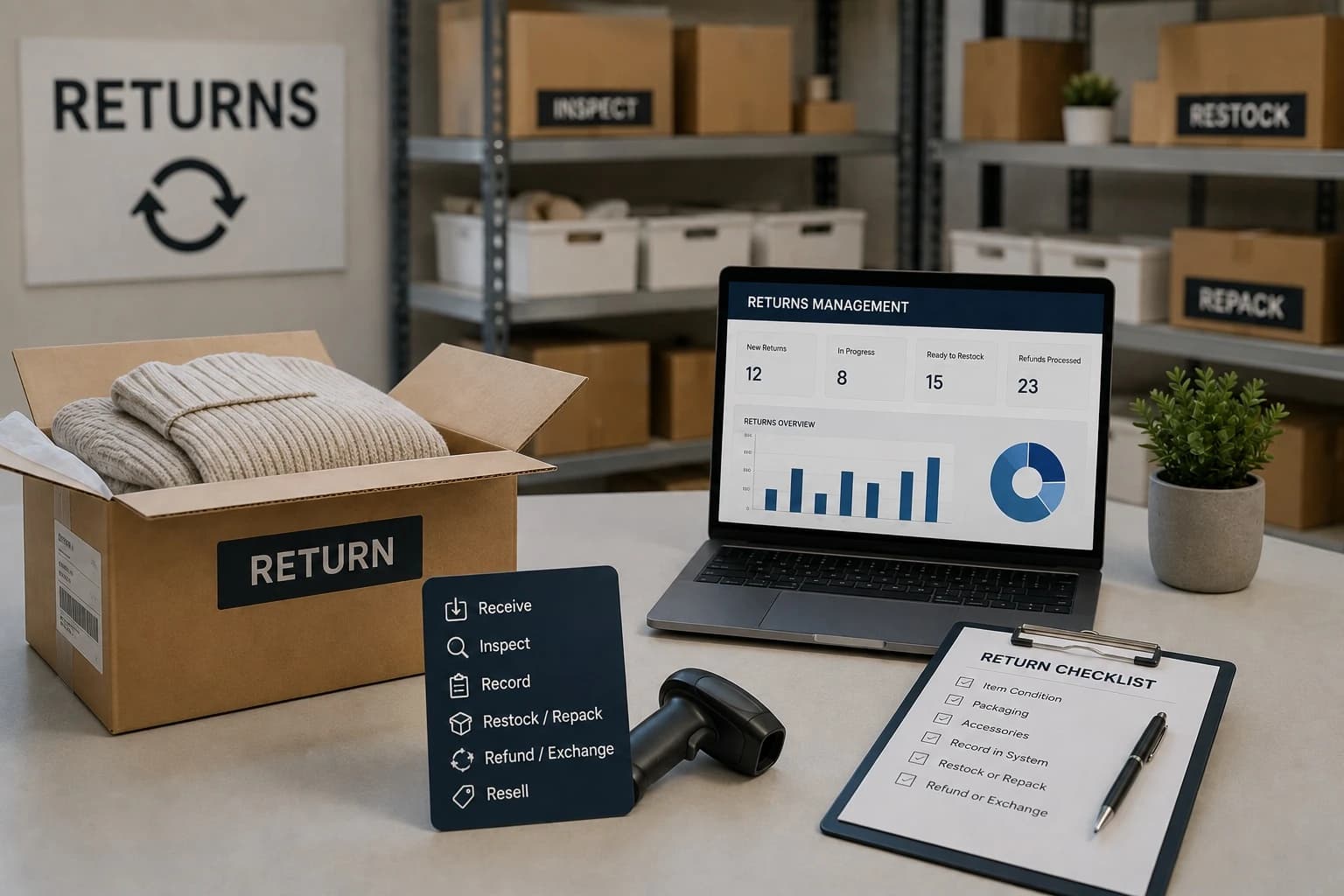
Returns are a normal part of e-commerce.
The challenge is not simply accepting a returned parcel. Businesses need to know what has been returned, what condition the product is in and what should happen to it next.
A structured returns management process can turn what would otherwise be a manual problem into a repeatable logistics workflow.
What Is Returns Management?
Returns management is the process of receiving and handling products sent back by customers.
It is sometimes referred to as reverse logistics because products move in the opposite direction to the original fulfilment process.
Instead of:
Warehouse → Customer
the process becomes:
Customer → Warehouse → Next Action
Step 1: Receiving the Return
The returned parcel arrives at the warehouse.
The shipment can then be identified using information such as:
- Tracking number
- Order information
- Customer reference
- SKU
- Return reference
The return is registered so the seller knows the parcel has arrived.
Step 2: Inspection
Depending on the service requested, the returned product can be checked.
Possible conditions include:
- Unopened
- Sellable
- Opened
- Packaging damaged
- Used
- Product damaged
- Missing components
The level of inspection should be agreed between the business and its logistics provider.
Step 3: Photography
For certain returns, photographs can help the seller make a decision without physically seeing the product.
Photos may be useful for:
- Damaged products
- Damaged packaging
- Incorrect items
- Missing parts
- High-value inventory
- Supplier claims
Step 4: Decide the Next Action
Once the return has been processed, several outcomes are possible.
Restock
If the product is in suitable condition, it may be returned to available inventory.
Repackage
A product may be usable but require new packaging before it can be sold again.
Hold
The product can remain in storage while the seller decides what to do.
Forward
The item can be sent to another warehouse, supplier, Amazon facility or another destination.
Dispose
Products that cannot be resold or returned elsewhere may be approved for disposal.
Why International Sellers Need a UK Returns Solution
International e-commerce businesses selling to UK customers may not have their own physical operation in the country.
This can make customer returns difficult and expensive.
A UK logistics partner can provide a local operational point where returns can be received and processed.
Instead of immediately shipping every returned product internationally, the seller can decide what happens after the product has been assessed.
Returns and Inventory Recovery
An efficient returns process is not only a customer-service function.
It can also help recover inventory.
A returned product that is still sellable may be inspected, repackaged and returned to stock instead of becoming a complete loss.
This is particularly valuable for businesses processing significant return volumes.
Returns Management with Shipext
Shipext provides UK-based returns processing as part of its wider 3PL and fulfilment operation.
Depending on client requirements, returned products can be:
- Received
- Registered
- Inspected
- Photographed
- Repacked
- Restocked
- Stored
- Forwarded
- Disposed of
Looking for a UK returns processing partner? Contact Shipext to discuss your expected return volume and required workflow.
Get in Touch